The Demo Worked Perfectly. Production Did Not.
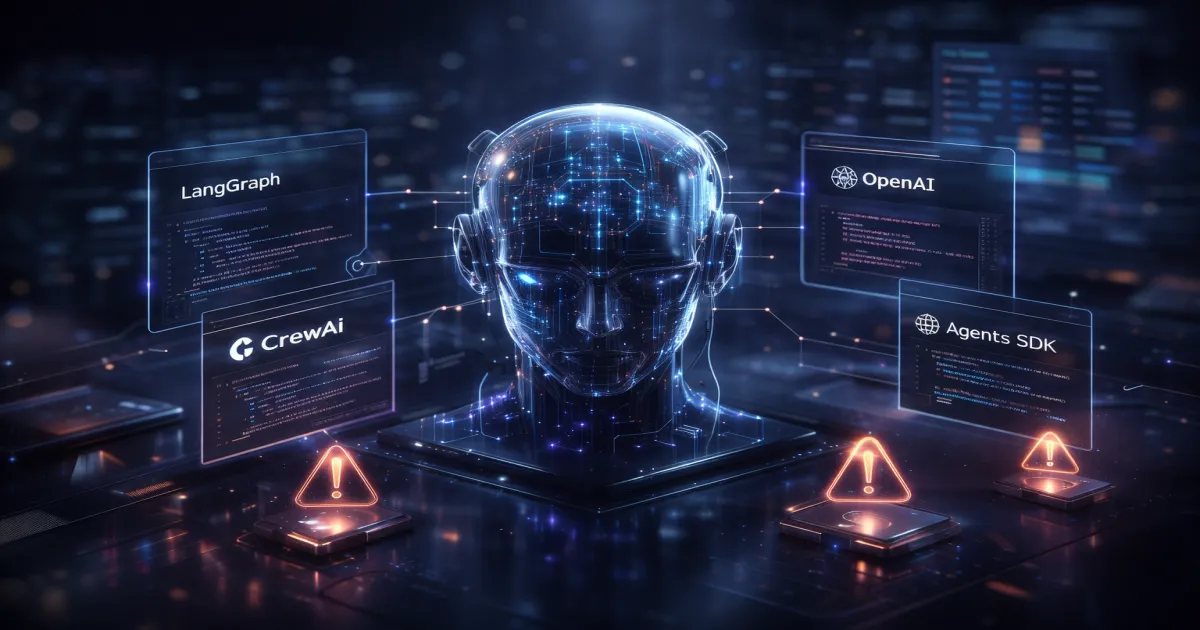
Every AI agent framework in 2026 ships with a demo that looks incredible. A multi-agent system that researches, reasons, and acts in sequence. LangGraph renders a clean state graph. CrewAI orchestrates a crew of specialists. OpenAI Agents SDK hands off between experts. In a controlled environment with a simple task, all of them work beautifully. The demo takes an afternoon to build, and the result feels like the future of software.
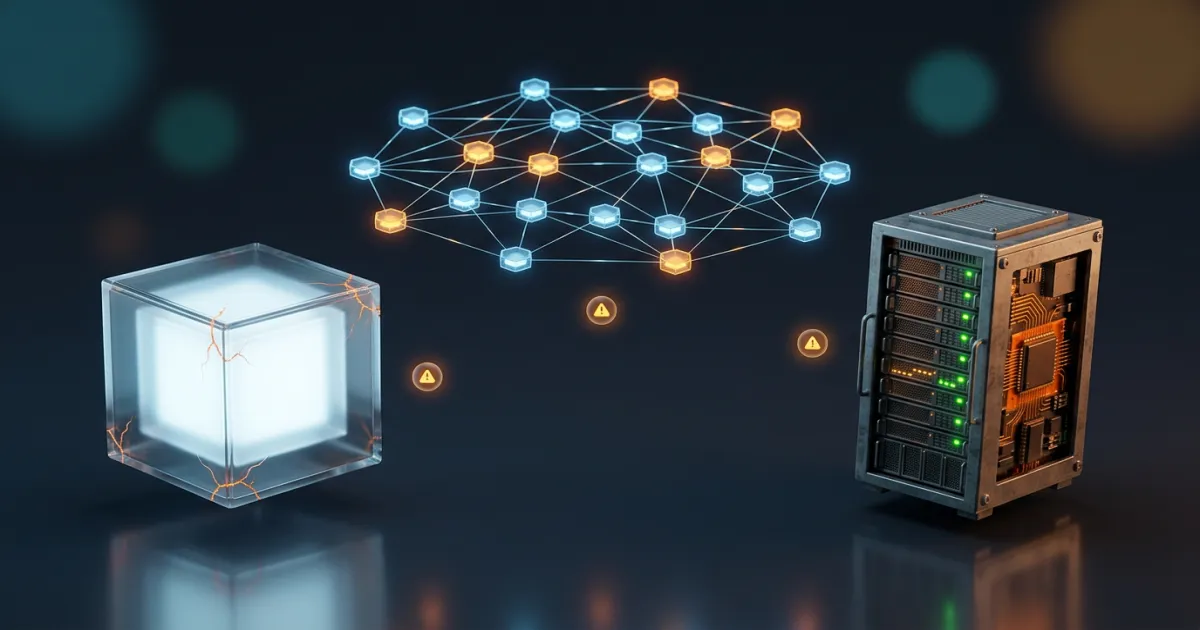
Then the team tries to put it into production. And the system that looked effortless in a notebook becomes something entirely different. Failures are silent. State management becomes a nightmare. Costs multiply in ways nobody modeled. Debugging feels like reading tea leaves. Within three months, the team is rebuilding the agent from scratch, often on a different framework. This is not an edge case. This is the dominant pattern. Research consistently shows that between 88% and 95% of AI agent pilots never reach production. Not because the technology is bad, but because the gap between demo and production is far larger than anyone expects.
The framework is never the reason the demo works. And it is rarely the reason production fails.
Why Every Framework Feels Like the Right Choice
The AI agent ecosystem in 2026 is mature enough that every major framework has genuine strengths. LangGraph has 34 million monthly PyPI downloads and is used in production by Klarna, Replit, and LinkedIn. CrewAI has 44,000 GitHub stars and claims idea-to-prototype in under four hours. OpenAI Agents SDK deploys a basic agent in three to five days with minimal code. Google ADK treats agents as microservice components with hierarchical orchestration. Claude Agent SDK provides native tool access with zero setup through Model Context Protocol.
None of these claims are exaggerated. Each framework genuinely delivers on its core promise in the context where that promise was designed to shine. The problem is that teams evaluate frameworks based on prototype experience and then commit to production with the same tool, assuming that the transition is a linear progression. It is not. The skills, architecture, and infrastructure required for production agents are fundamentally different from what demos require, and no framework abstracts that gap away.
This is the same false assumption that appears when teams evaluate AI SaaS tools based on first impressions. The initial experience creates confidence that does not transfer to production conditions.
The False Assumption That Kills Agent Projects
The mental model most teams carry is straightforward: pick the best framework, build the agent logic, deploy it, then optimize. This assumes that the framework is the primary variable in success, and that production is simply the demo running at higher volume with better error handling.
This is fundamentally wrong. The framework handles roughly 15 to 20 percent of what a production agent system actually requires. The remaining 80 percent is infrastructure that has nothing to do with the framework itself: durable execution, failure recovery, observability, cost control, state persistence, security boundaries, and human escalation logic. These are not features you bolt on later. They are architectural decisions that need to exist from the beginning, and they interact with the framework in ways that are invisible during prototyping.
The most dangerous part of this assumption is that it feels validated during the pilot phase. The pilot works because the environment is controlled, the input is predictable, and the team is watching the system manually. Production removes all three of those conditions simultaneously. That is where the 95% failure rate comes from, not from bad frameworks, but from systems that were never designed for the conditions they encounter.
A Pilot That Looks Perfect
Consider a realistic scenario. A B2B SaaS company builds an AI agent to automate customer support triage. The agent reads incoming tickets, classifies them by urgency and topic, routes them to the right team, and drafts an initial response. During the pilot, the team tests it on 200 tickets per day with a curated knowledge base and a single model.
The pilot results are impressive:
- 92% classification accuracy
- Average response time under 3 seconds
- Customer satisfaction unchanged from human triage
- Total infrastructure cost: ~$150/month
The team presents this to leadership. The decision is made to roll it out company-wide. The target is 5,000 tickets per day across multiple product lines, languages, and escalation paths.
Within six weeks, the system is in trouble:
- Classification accuracy drops to 74% on edge cases the pilot never encountered
- Multi-step reasoning chains fail silently, producing confident but wrong outputs
- Cost jumps to $2,800/month due to retry loops and fallback model escalation
- Debugging takes hours because there is no trace of what happened inside the agent's decision tree
- The team starts manually reviewing agent outputs, which defeats the purpose of automation
Nothing in the framework changed. The environment changed. And the framework was never designed to handle the difference.
Where Agent Frameworks Actually Break
The failure modes are consistent across frameworks because they stem from the gap between what frameworks provide and what production requires. These are not theoretical risks. They are the specific reasons teams rebuild.
Silent failures and confident wrong outputs Agents do not crash when they fail. They produce plausible but incorrect results. Without output validation and confidence scoring, bad outputs reach users undetected.
State loss across multi-step execution Long-running agent workflows lose context when steps fail mid-execution. Checkpointing exists in most frameworks, but automatic recovery and duplicate prevention do not.
Cost multiplication from retry and fallback loops When a step fails, agents retry. When retries fail, they escalate to more expensive models. A single failed interaction can trigger 5 to 15 model calls instead of the expected 2 to 3.
Debugging opacity Agent decisions are nested, branching, and non-deterministic. Standard logging captures inputs and outputs but not the reasoning chain between them. Debugging a production failure requires reconstructing a path that the system itself does not record by default.
Tool execution side effects Agents that write to databases, call external APIs, or trigger workflows create side effects that are difficult to reverse when the agent makes a mistake. Idempotency is not built into any framework by default.
Scenario 1: Early Stage Pilot
A startup building an internal research agent for market analysis.
- 100 agent runs per day
- Single agent, 3 tools (web search, summarization, database write)
- Simple linear workflow, no branching
- 1 developer maintaining the system
LangGraph:
- Framework: free (open source)
- LLM cost: ~$8/day (~800 tokens/request, GPT-4o)
- Infrastructure: minimal, single server
- Total: ~$250/month
CrewAI:
- Framework: free tier
- LLM cost: ~$12/day (~1,250 tokens/request due to per-agent system prompt overhead)
- Infrastructure: minimal
- Total: ~$380/month
OpenAI Agents SDK:
- Framework: free
- LLM cost: ~$10/day (efficient for single-agent, but locked to OpenAI pricing)
- Infrastructure: minimal
- Total: ~$310/month
At this stage, cost differences are negligible and the choice should be driven by developer familiarity. CrewAI is fastest to prototype. LangGraph is most token-efficient. OpenAI SDK is simplest if you are already in the OpenAI ecosystem. None of them will cause problems at this scale.
Scenario 2: Growth Stage
The same company scaling to a customer-facing agent handling support and onboarding.
- 2,000 agent runs per day
- Multi-agent system: classifier, researcher, responder, escalation handler
- Branching logic with conditional tool execution
- 3 developers, need for observability and debugging
- Retry and fallback logic required
LangGraph:
- Framework: free
- LangSmith observability: $39/seat x 3 = $117/month
- LLM cost: ~$65/day (token-efficient, ~800 tokens/request across 4 agents)
- Infrastructure: managed deployment, moderate compute
- Total: ~$2,200/month
CrewAI:
- Framework: Enterprise tier ~$25/month
- LLM cost: ~$100/day (1,250 tokens/request, per-agent prompt overhead compounds across 4 agents)
- Infrastructure: similar compute requirements
- Observability: third-party tooling ~$100/month
- Total: ~$3,200/month
OpenAI Agents SDK:
- Framework: free
- LLM cost: ~$80/day (efficient handoff model, but no model choice flexibility)
- Infrastructure: OpenAI-dependent, limited optimization levers
- Tracing: built-in, but limited compared to LangSmith
- Total: ~$2,600/month
This is where the differences start compounding. LangGraph's token efficiency saves ~$1,000/month over CrewAI at this volume. More critically, LangGraph's observability through LangSmith becomes essential for debugging multi-agent failures. CrewAI's simplicity advantage from the pilot phase starts becoming a limitation because customizing agent behavior requires fighting the framework's abstractions. OpenAI SDK's model lock-in prevents cost optimization through model routing.
Scenario 3: Scale Stage
Production system handling critical business workflows.
- 15,000 agent runs per day
- 6 specialized agents with complex orchestration
- Durable execution required (financial transactions, customer data)
- Human-in-the-loop for high-stakes decisions
- Full observability, audit trail, and compliance requirements
- 8 developers across agent and infrastructure teams
LangGraph:
- Framework: free
- LangSmith: $39/seat x 8 = $312/month
- LLM cost: ~$400/day (optimized with model routing, mixing GPT-4o and smaller models)
- Infrastructure: dedicated compute, state persistence, queue management
- Custom observability and guardrails: significant engineering investment
- Total: ~$13,500/month
CrewAI:
- Framework: Enterprise
- LLM cost: ~$620/day (token overhead compounds dramatically across 6 agents at 15K runs)
- Infrastructure: similar base requirements
- Custom tooling to work around framework limitations: substantial
- Total: ~$20,000/month
OpenAI Agents SDK:
- Framework: free
- LLM cost: ~$500/day (no model routing flexibility, locked to OpenAI pricing)
- Infrastructure: OpenAI-dependent scaling
- Compliance and audit: requires significant custom development
- Total: ~$16,500/month
At scale, LangGraph's advantages become decisive. Token efficiency across millions of daily requests creates a $6,000 to $7,000/month cost gap over CrewAI. But more importantly, LangGraph's graph-based architecture allows teams to reason about agent behavior structurally, which is critical for debugging, auditing, and compliance. CrewAI's role-based abstraction, which made prototyping fast, now makes production debugging extremely difficult because the framework controls too much of the execution flow.
This cost explosion pattern mirrors what happens across all AI systems at scale, as explored in why AI cost explodes after scale. The per-request cost is not the problem. The system behavior that multiplies that cost is.
Where Cost Actually Leaks in Agent Systems
Agent frameworks create cost structures that are invisible during prototyping because they only manifest under production conditions. The framework cost itself is almost always free. The real cost lives in how the framework shapes system behavior.
Per-agent prompt overhead CrewAI adds ~150 tokens of system prompt per agent per request. In a 4-agent system processing 10,000 requests daily, this creates 6 million unnecessary tokens per day, roughly $24/day in pure overhead.
Retry amplification When an agent step fails, the framework retries. But each retry includes the full context window, not just the failed step. A 3-retry sequence on a 2,000-token request costs 8,000 tokens, not 6,000, because context accumulates.
Fallback model escalation Teams route simple requests to cheaper models and complex ones to expensive models. When classification fails, expensive models handle everything. A 10% misclassification rate can increase total LLM cost by 30 to 40%.
Observability infrastructure LangSmith costs $39/seat/month. Third-party tracing tools cost $100 to $500/month. Without them, debugging production agents is nearly impossible, so they are not optional.
Rebuild engineering cost The most expensive leak is invisible. When teams rebuild their agent system every 3 months because the current framework hit a wall, they lose 4 to 8 weeks of engineering time per cycle. At an average loaded cost of $15K/month per engineer, a 3-person team rebuild costs $30K to $60K per cycle.
Hidden Cost Breakdown
| Component | Visibility | Cost Impact | What Teams Usually Miss |
|---|---|---|---|
| LLM inference (base) | High | Medium | What dashboards show |
| Per-agent prompt overhead | Low | Medium | Framework-specific tax |
| Retry amplification | Low | High | Compounds with failure rate |
| Fallback escalation | Low | High | Misclassification drives expensive calls |
| Observability tooling | Medium | Medium | Required but not budgeted |
| Rebuild cycles | Very Low | Very High | 3-month framework migrations destroy velocity |
| Engineering time debugging | Low | High | Hours per incident, invisible in infra billing |
Most teams budget for LLM tokens. The actual cost is in the engineering time spent fighting the framework.
Why 95% of Agent Pilots Fail to Scale
The 95% failure rate is not a technology problem. It is an architecture problem driven by a specific set of patterns that repeat across organizations regardless of which framework they use.
Research from enterprise deployments shows four dominant failure modes:
Process mirroring (38% of failures): Teams automate existing human workflows instead of redesigning for autonomous execution. An agent that follows the same steps a human would is inherently brittle because humans adapt in real-time while agents follow fixed paths. The workflow needs to be restructured around the agent's strengths, not copied from the human version.
No observability (27% of failures): Agents operate as black boxes with no audit trail. When something goes wrong, there is no way to determine what the agent decided, why it decided it, or where the chain of reasoning broke down. Without trace-level observability, every production incident becomes a manual investigation that can take hours.
Context collapse (22% of failures): Multi-step agent pipelines lose task context across step boundaries. The agent completes step one successfully, but by step three, the relevant context from step one has been truncated or summarized away. This produces outputs that are locally correct but globally wrong, the hardest type of failure to detect.
Tool overload (13% of failures): Teams give a single agent access to 30 or more tools without priority routing or specialization. The agent spends tokens reasoning about which tool to use instead of executing the task. Tool selection becomes the bottleneck, and accuracy drops because the model's attention is divided across too many options.
These failure modes interact with each other. A system with no observability cannot detect context collapse. A process-mirrored workflow creates tool overload because it maps human flexibility onto rigid tool interfaces. The failures compound, which is why the transition from pilot to production feels like hitting a wall rather than climbing a gradient.
| Failure Mode | Frequency | Root Cause | Why Frameworks Do Not Solve It |
|---|---|---|---|
| Process mirroring | 38% | Workflow design, not technology | Frameworks execute workflows, they do not design them |
| No observability | 27% | Missing infrastructure layer | Observability is external to the agent framework |
| Context collapse | 22% | State management across steps | Checkpointing exists, but automatic recovery does not |
| Tool overload | 13% | Architecture decision | Frameworks provide tool access, not tool strategy |
The framework gives you the ability to build agents. It does not give you the ability to operate them.
The Framework Decision Most Teams Get Wrong
The real difference between agent frameworks is not capability. It is where complexity lives and how much control you retain over it. Every framework makes a trade-off between ease of use and operational control, and that trade-off determines how the system behaves when things go wrong.
LangGraph exposes complexity explicitly. The graph-based model forces you to define states, transitions, and failure paths upfront. This makes initial development slower, but it means the system is observable and debuggable by design. When a production incident occurs, you can trace the exact path the agent took through the graph and identify where it diverged from expected behavior. The trade-off is that you write significantly more code, and the learning curve is steep for teams without graph-based programming experience.
CrewAI hides complexity behind role-based abstractions. You define agents as personas with goals and backstories, and the framework handles orchestration. This makes prototyping extremely fast, often hours instead of days, but it creates a ceiling. When production requires custom failure handling, conditional logic, or fine-grained state management, you start fighting the framework's abstractions instead of building on them. The role-based model that made things simple now makes things rigid.
OpenAI Agents SDK sits in between. It provides clean primitives (agents, handoffs, guardrails, tools) with minimal abstraction. Development is fast and the code is readable. But the model lock-in is real. You cannot route requests to cheaper models for simple tasks or use open-source models for cost optimization. At scale, this constraint becomes the dominant cost driver. The framework supports over 100 non-OpenAI models technically, but the handoff and guardrail features are optimized for OpenAI's API behavior.
Google ADK treats agents as microservice components with explicit session management and hierarchical orchestration. It is the most enterprise-oriented option, designed for teams that think in terms of service architecture rather than AI workflows. The trade-off is that it requires the most infrastructure investment upfront and has the deepest vendor integration with Google Cloud.
| Framework | Core Philosophy | Where Complexity Lives | Best For | Ceiling |
|---|---|---|---|---|
| LangGraph | Explicit graph-based control | In your code (visible) | Production systems requiring auditability | Learning curve, initial development speed |
| CrewAI | Role-based abstraction | Inside the framework (hidden) | Rapid prototyping, simple multi-agent tasks | Complex production requirements |
| OpenAI SDK | Minimal primitives | In OpenAI's ecosystem | Teams already committed to OpenAI | Model lock-in, cost optimization limits |
| Google ADK | Microservice architecture | In infrastructure design | Enterprise with Google Cloud investment | Vendor dependency, setup complexity |
This is the same tension that exists across all infrastructure architecture decisions, where convenience early creates constraints later, and the cost of those constraints only becomes visible at scale.
The Real Cost Formula
A more useful way to model agent system cost, beyond just LLM tokens:
total agent cost = (LLM inference x retry rate x agent count) + observability + rebuild cycles + engineering time per incident
Where:
- LLM inference is the base token cost per request
- Retry rate multiplies inference cost by 1.3x to 2x in production
- Agent count multiplies per-agent prompt overhead (significant in CrewAI)
- Observability is the fixed cost of tracing and monitoring tools
- Rebuild cycles is the engineering cost of framework migrations (typically every 3 to 6 months)
- Engineering time per incident is the debugging cost that scales with system opacity
Practical Interpretation
| Variable | Low Cost Indicator | High Cost Indicator |
|---|---|---|
| LLM inference | Simple tasks, small context windows | Complex reasoning, large context |
| Retry rate | Deterministic workflows, strong guardrails | Non-deterministic, weak validation |
| Agent count | Single agent, focused task | 5+ agents with cross-dependencies |
| Observability | LangSmith or built-in tracing | Custom tooling, compliance requirements |
| Rebuild cycles | Stable framework choice, clear requirements | Evolving use case, framework limitations |
| Engineering time | Observable system, clear failure paths | Black box agents, complex orchestration |
Most teams only model LLM inference cost. The ones that survive production model all six variables.
The Trade-Off Table
| Decision | What You Gain | What You Pay | When It Breaks |
|---|---|---|---|
| CrewAI for fast prototype | Prototype in hours, intuitive mental model | Limited production control, higher token overhead | When requirements exceed role-based abstraction |
| LangGraph for production | Full control, observability, token efficiency | Steep learning curve, slower initial development | When team lacks graph programming experience |
| OpenAI SDK for simplicity | Clean API, fast deployment, built-in tracing | Model lock-in, limited cost optimization | When you need model routing or open-source models |
| Google ADK for enterprise | Hierarchical agents, session management | Heavy infrastructure investment, Google dependency | When team is not already on Google Cloud |
| Framework migration | Escape current limitations | 4-8 weeks of lost engineering velocity | When the new framework has its own limitations |
| Build custom orchestration | Full control, no framework dependency | Significant upfront investment, maintenance burden | When team underestimates the scope |
When Each Framework Makes Sense
Choose LangGraph when:
- The system will handle production workflows with real business impact
- Observability and auditability are non-negotiable requirements
- Token cost optimization matters at your scale (10K+ requests/day)
- The team has or can develop graph-based programming skills
- Long-term maintainability matters more than time-to-prototype
Choose CrewAI when:
- You need a working prototype in days, not weeks
- The use case is well-defined and unlikely to evolve significantly
- Multi-agent coordination is needed but complexity is moderate
- The team values speed of development over production control
- You accept that migration to a different framework may be necessary later
Choose OpenAI Agents SDK when:
- The team is already deep in the OpenAI ecosystem
- Multi-agent handoff patterns are the core architecture
- Built-in tracing and guardrails meet your observability needs
- Model lock-in is acceptable given OpenAI's model quality
- Simplicity of code and deployment is the primary constraint
Choose Google ADK when:
- The organization runs on Google Cloud infrastructure
- The system requires hierarchical agent orchestration
- Enterprise session management and security are requirements
- The team thinks in service architecture patterns
- Long-term vendor alignment with Google is strategically acceptable
The wrong decision is not choosing the wrong framework. It is choosing based on the pilot experience and assuming production will be a scaled version of the same thing. It is not. Production is a fundamentally different environment, and the framework that felt perfect in a notebook may become the primary obstacle at scale. This is the same timing mistake that appears across infrastructure decisions, where the right tool at the wrong time creates more problems than the wrong tool at the right time.
The Mistake Most Teams Make
Most teams choose an agent framework based on how fast they can build a demo. This is rational for the pilot phase but catastrophic for production. The demo tests whether the framework can orchestrate a simple workflow. Production tests whether the system can handle failure, cost pressure, debugging, compliance, and evolution over months of operation. These are entirely different evaluation criteria, and optimizing for one actively works against the other.
The second mistake is treating framework migration as a low-cost option. Teams assume that if the current framework hits a wall, they can switch. In reality, agent systems accumulate state management patterns, tool integrations, prompt engineering, and operational knowledge that are deeply framework-specific. A migration is not swapping one library for another. It is rebuilding the system from the ground up, and every rebuild resets the clock on production learning by 4 to 8 weeks.
The Part Nobody Wants to Hear
The question is not which agent framework is best for production.
The real question is:
Are you building an agent, or are you building the infrastructure to operate one?
Because the framework handles the agent. Everything else, the failure recovery, the observability, the cost control, the human escalation, the audit trail, that is infrastructure. And infrastructure is what determines whether the system survives its first month in production.
95% of agent pilots fail not because the framework was wrong, but because the team built an agent without building the system around it.
The framework is the easiest part of an agent system. Everything that makes it work in production has nothing to do with the framework.