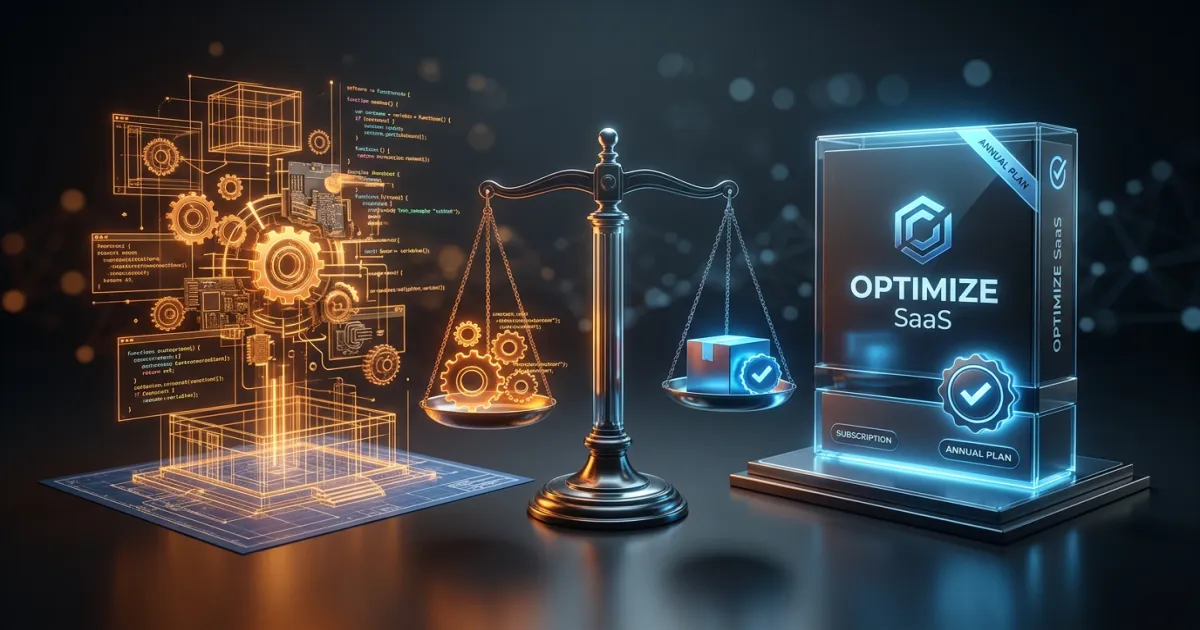
Open Source Is Not Automatically the Cheaper Option
Open source often wins the first conversation because the license cost is low or nonexistent.
At a glance, this feels like the more responsible financial decision, especially when compared to a recurring SaaS subscription.
But in practice, cost is rarely that simple.
Software cost is not just about what you pay upfront. It includes setup time, maintenance, infrastructure, reliability, security, and the ongoing attention required to keep everything running.
Once these factors are included, the difference between open source and SaaS becomes less obvious.
A Better Way to Compare Cost
| Cost area | Open source | SaaS |
|---|---|---|
| License cost | Low or zero | Recurring subscription |
| Setup effort | Often higher | Usually lower |
| Infrastructure | Your responsibility | Managed or abstracted |
| Maintenance | Your team owns it | Vendor handles most of it |
| Customization | High | Usually medium |
| Opportunity cost | Often underestimated | Lower if the tool fits |
The key insight is that open source does not remove cost. It shifts where the cost appears.
Where Open Source Works Well
Open source makes sense when customization is critical or when the team already has the technical depth to support it.
It can also be the right choice when long-term SaaS costs would become disproportionately high relative to the value delivered.
For example, infrastructure-heavy products or systems with unique requirements often benefit from owning the stack.
However, this only works if the team is prepared to handle the operational burden that comes with it.
Where SaaS Works Better
SaaS is often the better choice when speed matters more than control.
A managed product reduces setup time, removes patching responsibility, and absorbs operational complexity that would otherwise fall on the team.
For early-stage companies, this trade-off is usually worth it.
Time spent maintaining internal systems is time not spent improving the core product.
This is why SaaS decisions are often closely tied to broader questions about focus and leverage, as explored in build vs buy decisions.
The Hidden Cost of Open Source
The real cost of open source rarely appears on the invoice.
It shows up in:
- upgrades and dependency management
- performance monitoring
- security patches
- internal documentation
- support requests
A useful way to think about this is to ask: what happens if the person who set this up leaves?
If the system becomes fragile, then the cost was never actually low. It was deferred.
The Hidden Cost of SaaS
SaaS has its own risks.
- vendor lock-in
- pricing changes
- limited customization
- dependency on external roadmap
At scale, these constraints can become meaningful.
This is especially true for usage-based pricing models, where cost can grow faster than expected, which is why understanding SaaS pricing models is important when evaluating long-term cost.
A Practical TCO Framework
| Question | Lean SaaS | Lean Open Source |
|---|---|---|
| Do you need to move quickly? | Yes | No |
| Is customization critical? | No | Yes |
| Do you have strong internal ops? | No | Yes |
| Will SaaS cost scale significantly? | Maybe | Yes |
| Is this core to your product? | No | Yes |
This framework is useful because it connects technical decisions to business context.
Stage Matters More Than Philosophy
For most early-stage startups, SaaS is usually the more practical choice.
It allows teams to move faster and focus on building the core product.
As the company grows, open source may become more attractive if cost or customization becomes more important.
In many cases, the best approach is staged:
- start with SaaS
- learn what matters
- replace selectively if needed
This approach reduces risk while preserving flexibility.
Connection to Your Stack
This decision rarely exists in isolation.
It is often part of a broader question about how the entire stack is structured.
For example, early-stage teams tend to favor simpler setups to reduce operational overhead, which is why decisions like this are closely connected to building a lean system, as described in bootstrapping a SaaS tool stack.
Final Takeaway
Open source is not free. SaaS is not always expensive.
The real question is not which one is cheaper.
It is which one aligns better with your team's capabilities, your product needs, and your stage of growth.
Choose SaaS when speed and focus matter.
Choose open source when control and customization create real leverage.
And always evaluate total cost of ownership, not just visible price.