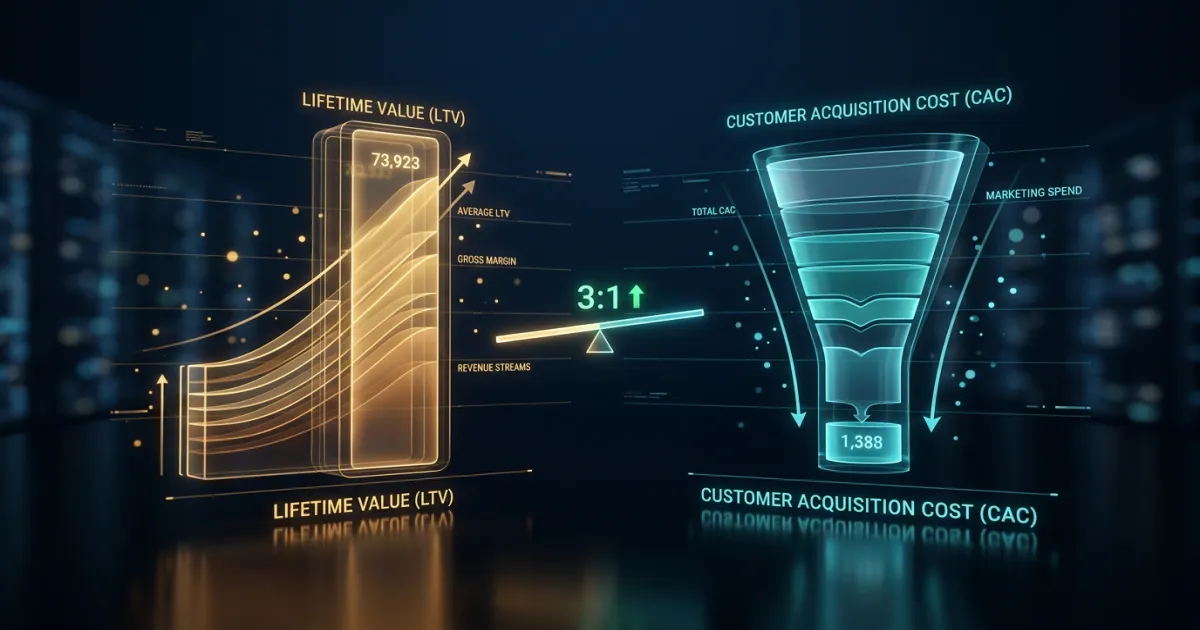
LTV vs CAC Is Not Just a Metric
LTV (Lifetime Value) and CAC (Customer Acquisition Cost) are often presented as simple ratios.
In reality, they are one of the clearest indicators of whether a SaaS business actually works.
You can have growth, users, and revenue, but if LTV does not significantly exceed CAC, the model breaks at scale.
What LTV Really Represents
LTV is not just total revenue per customer.
It reflects:
- how long customers stay
- how much they expand
- how pricing captures value
A product with strong retention but weak pricing may still have low LTV. A product with strong expansion can compensate for moderate churn.
This is why LTV is deeply connected to both churn and pricing structure.
What CAC Actually Includes
CAC is often underestimated.
It is not just ad spend. It includes:
- marketing costs
- sales salaries
- tools and infrastructure
- time to close deals
For sales-led SaaS, CAC can be significantly higher than expected. For self-serve products, CAC may look low initially but increase as competition grows.
The LTV / CAC Ratio in Practice
The common benchmark is:
| LTV / CAC | Interpretation |
|---|---|
| < 1 | Losing money on customers |
| 1 – 3 | Weak or inefficient growth |
| 3 – 5 | Healthy SaaS business |
| > 5 | Strong, but possibly under-investing |
But this table alone is misleading.
A ratio of 5 sounds great, but if growth is slow, it may indicate underinvestment. A ratio of 2 might be acceptable if growth is rapid and improving.
Context matters more than the number.
Why Many Calculations Are Wrong
Most LTV calculations are overly optimistic.
They assume:
- low churn
- stable expansion
- long retention
In reality, small changes in churn can dramatically reduce LTV. This is why understanding churn dynamics is critical, as explored in SaaS churn analysis.
Similarly, CAC is often incomplete, especially when internal costs are ignored.
Pricing’s Impact on LTV
Pricing decisions directly influence LTV.
A higher price increases LTV immediately, but may increase churn. A lower price may improve retention but reduce revenue per customer.
Usage-based pricing introduces another dynamic. As customers grow, LTV can increase significantly without requiring new acquisition.
This is why pricing models are not just about billing, they shape financial outcomes over time.
Payback Period: The Missing Piece
LTV/CAC ratio is incomplete without payback period.
Payback period answers:
how long it takes to recover CAC
| Payback period | Meaning |
|---|---|
| < 6 months | Very efficient |
| 6–12 months | Healthy |
| 12–18 months | Risky |
| > 18 months | Problematic |
A good LTV/CAC ratio with a long payback period can still create cash flow problems, especially in early-stage companies.
Connecting This to Runway
LTV and CAC are closely tied to runway.
If CAC is high and payback is slow, the company burns cash faster. This directly impacts survival, as discussed in burn rate and runway.
This is why many startups fail not because they cannot grow, but because they run out of cash before growth becomes efficient.
A More Practical Interpretation
Instead of focusing on exact numbers, a better approach is to ask:
- is CAC decreasing over time?
- is LTV increasing through expansion?
- is payback getting shorter?
These trends matter more than static ratios.
Final Takeaway
LTV and CAC are not just metrics to report.
They are a way to understand whether your business model is sustainable.
When LTV grows through retention and expansion, and CAC remains controlled, growth becomes durable. When they are misaligned, growth becomes fragile, no matter how fast it looks in the short term.